

4OVEK 450 SO
For grinding Capto workpieces
“Automated grinding of Capto workpieces for maximum productivity”
SwissChuck developed a special chuck specifically for clamping Capto workpieces. The Capto blank is located in the gripping grooves, aligned, and securely clamped. The Capto interface is then ground, including the polygonal profile and the adjacent end face.The chuck features a rapid radial jaw stroke of 39 mm, allowing it to accommodate even large blanks with diameters of up to 130 mm. The rapid stroke is followed by a radial clamping stroke of 2 mm, ensuring that the workpieces are clamped with the required accuracy and force.
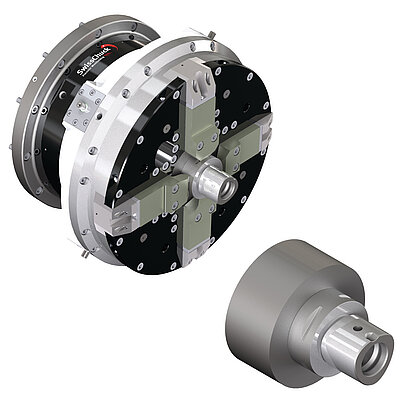
Technical Data
Precision Four-Jaw Chuck
| Typ | Item | ø Size (mm) | High (mm) | max. Capto Size | Clamping force (kN) | Max. speed (1/min) | Stroke per jaw (mm) | Weight (kg) |
| 4OVEK 450 SO Power Chuck | SX1042241 | 450 | 274 | C10 | 60 | 300 | 40 | 218 |
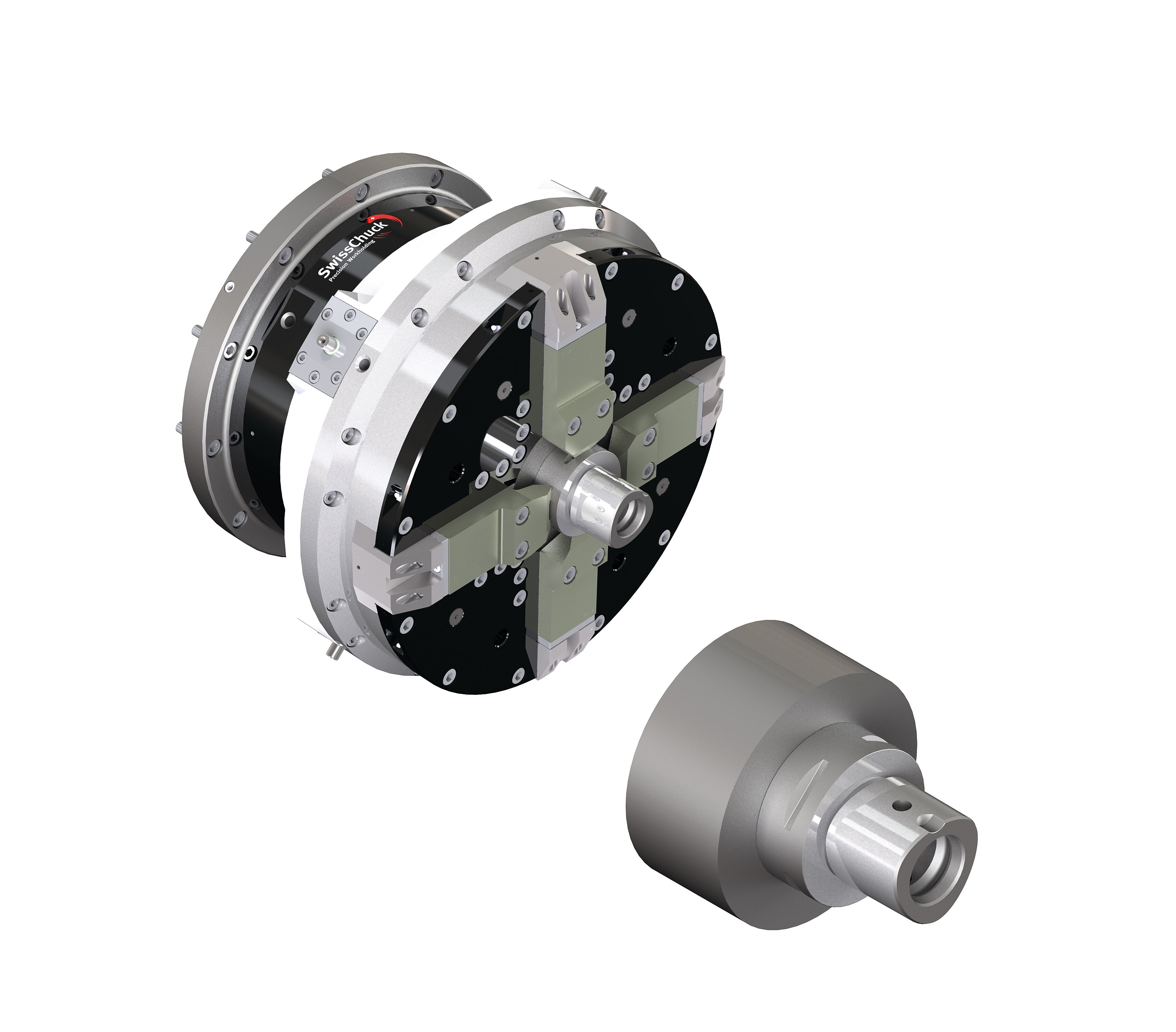
Functions & Applications
- Grinding of Capto blanks, sizes C3–C10
- Hydraulically actuated four-jaw chuck with special functions
- Rapid radial stroke: 39 mm
- Precision radial stroke: 2 mm
- Clamping over workpiece bodies up to Ø130 mm for size C6
- Reach depth of 200 mm for Ø90 mm
- Precisely matched top jaws → jaw changes without readjustment
- Clamping repeatability ≤ 0.01 mm
Advantages
- Precisely matched top jaws → jaw changes without readjustment
- Clamping repeatability ≤ 0.01 mm
- Interchangeable top jaws for workpiece sizes C3 to C8
- Sealed chuck with air purge protection in the jaw area
- Stable and secure clamping
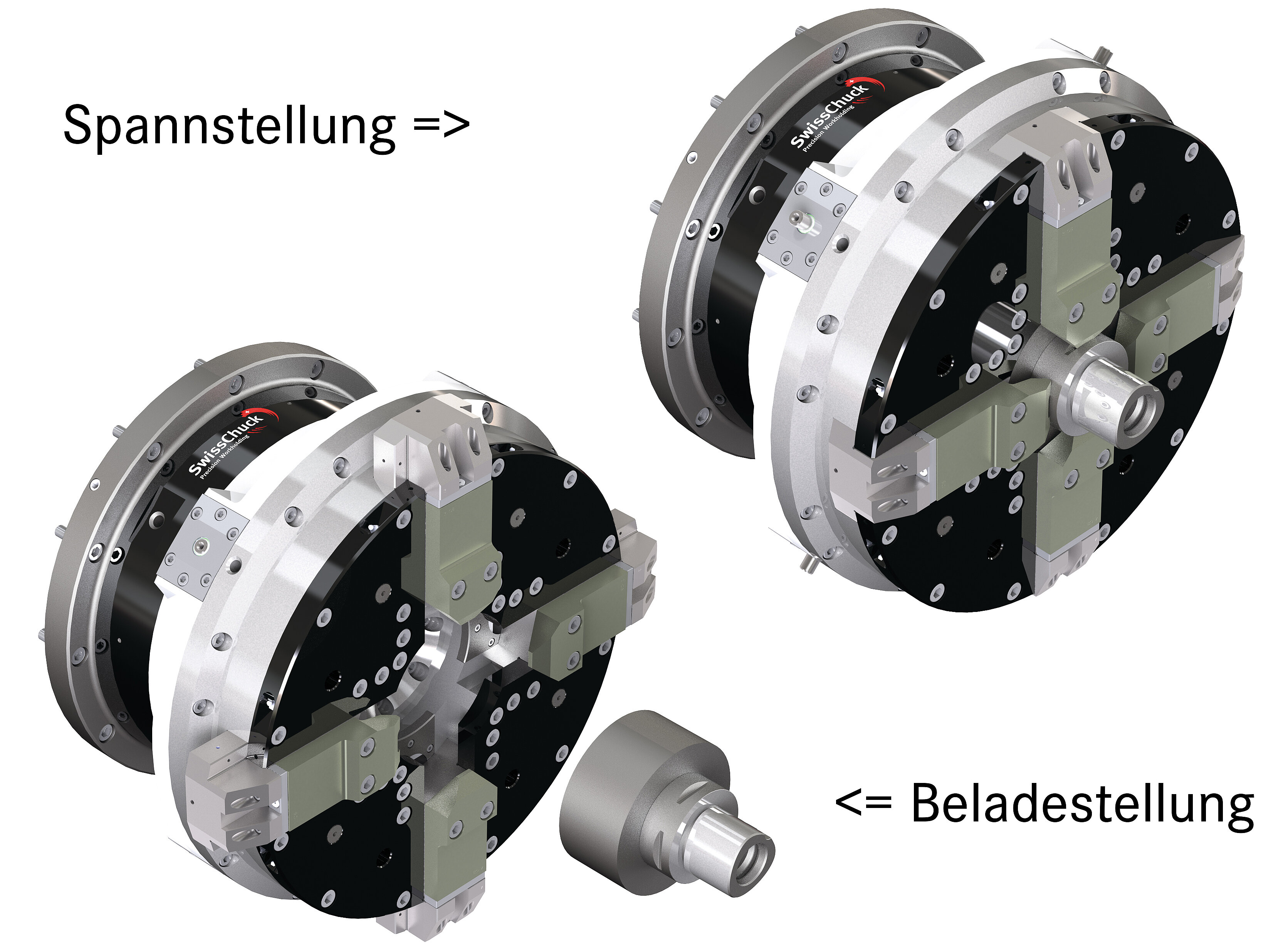
Clamping over large blanks thanks to a 41 mm jaw stroke!
The jaws of this special chuck provide a maximum stroke of 41 mm, allowing them to clamp over large blanks with diameters of up to 130 mm. The jaw stroke is divided into a 39 mm rapid stroke and a 2 mm clamping stroke. Both functions are hydraulically actuated, providing a maximum clamping force of 60 kN.The two pairs of jaws can be controlled independently. The first pair closes at low hydraulic pressure and aligns the workpiece using the gripping grooves. The second pair then closes at low pressure to center the Capto workpiece. Finally, high hydraulic pressure is applied to generate the required clamping force.